What Is Laser Cleaning?
Dawn Huang | Founder of Chihalo Laser | M.Sc. Engineering (HKU)
Hi! I am Dawn. With 10 years of field experience, I specialize in laser cleaning systems—from optical sourcing to automation. I write here to turn complex specs into actionable buying guides.
Welcome to contact me at dawn@chihalo.com or WhatsApp at +86 18608325040!
Table of Contents
Laser cleaning is a process that uses pulsed laser light to strip rust, paint, oil, and other unwanted materials from surfaces—without chemicals, without abrasives, and without damaging what’s underneath.
The technology has been around since the 1990s, but costs have dropped sharply in the past decade. A system that cost $500,000 in 2010 might run $50,000 today. That price shift explains why everyone from Boeing to small fabrication shops now uses laser cleaning for jobs that once required sandblasting crews or chemical baths.
I’ve watched this technology move from “interesting lab demo” to “factory floor standard” over 15 years in the surface treatment industry. This guide covers what we’ve learned: how the process actually works, what it costs in the real world, where it makes sense to use, and where it doesn’t.
How Laser Cleaning Actually Works
The core principle is simple: different materials vaporize at different energy levels.
Rust needs relatively little energy to vaporize. Steel needs a lot more. So you set the laser to deliver enough energy to vaporize rust, but not enough to touch the steel underneath. The rust disappears; the steel stays clean and undamaged.
Engineers call this the “ablation threshold”—the minimum energy density required to vaporize a specific material. Every substance has its own threshold. Rust sits low on the scale. Paint is somewhere in the middle. Metals like steel and aluminum sit much higher.
What Happens at the Surface
When the laser pulse hits contaminated metal, several things happen in microseconds:
The contaminant absorbs the light energy and heats up instantly—we’re talking temperature jumps of thousands of degrees in nanoseconds. At these temperatures, the rust or paint doesn’t melt; it goes straight from solid to gas (sublimation) or explodes off as tiny particles. Meanwhile, the metal underneath barely notices. It might warm up a few degrees. The pulse is too short and the energy too low to do any real heating.
A fume extractor pulls away the vaporized material, and you’re left with clean metal.
Pulsed Lasers vs. Continuous Wave
Most cleaning applications use pulsed lasers. The pulses concentrate energy into extremely short bursts—typically 100 to 200 nanoseconds. This creates high peak power without sustained heating.
Continuous wave (CW) lasers run constantly, like a flashlight. They’re faster for large areas but transfer more heat. Some operators use CW for heavy rust on thick steel plate where a little heat won’t matter. But for anything precision—aerospace parts, molds, thin materials—pulsed is the standard.
Pulsed | Continuous Wave | |
Heat to substrate | Minimal | Moderate to high |
Best for | Precision work, thin parts | Heavy contamination, thick steel |
Speed | Moderate | Fast |
Risk of damage | Very low | Low to moderate |
Price range | $3K-$25K | $4K-$12K |
Where Laser Cleaning Gets Used
The applications break down into two categories: what you’re removing, and what industry you’re in.
Common Removal Tasks
Rust removal is the bread-and-butter application. Laser handles light surface rust to heavy scale, though very thick rust (over 1mm) gets slow. Most users report 20-50 square feet per hour on moderate rust with a 200W system.
Paint stripping works well on most coatings. Single layers come off fast. Multi-layer paint systems take multiple passes. One aerospace contractor told us they strip primer and topcoat from aluminum panels in about 4 minutes per square foot—half the time of chemical stripping, with no disposal costs.
Oxide removal is critical for welding prep. The laser strips oxides from aluminum and stainless steel right before welding, which reduces porosity and cracking. Some shops run laser cleaning inline, seconds before the weld head.
Mold cleaning has become a major application. Tire molds and injection molds collect residue that affects part quality. Traditional cleaning methods (dry ice, chemicals) can wear mold surfaces over time. Laser removes the residue without touching the mold steel.
Industry Adoption
Industry | Typical Applications |
Aerospace | Coating removal, surface prep for bonding, turbine blade cleaning. Boeing and Airbus suppliers have standardized on laser for many prep tasks. |
Automotive | Weld prep on body panels, battery tray cleaning for EVs, mold maintenance. Tesla and several German OEMs use laser cleaning in battery production. |
Shipbuilding | Hull rust removal, coating prep. Still emerging—most yards use abrasive blasting, but laser is gaining for spot repairs. |
Power Generation | Turbine cleaning, nuclear decontamination. DOE has funded research on laser cleaning for radioactive surface decontamination. |
Tool & Die | Mold cleaning, die maintenance. Tire manufacturers were early adopters. |
What Laser Cleaning Actually Costs
Let’s talk real numbers. Pricing varies by manufacturer, but here’s what the market looks like in early 2025:
Equipment Pricing
Type | Power | Price (USD) | Good For |
Entry handheld | 50-100W | $3K-$6K | Light rust, small parts, testing |
Mid handheld | 200-300W | $8K-$9.8K | General industrial use |
High-power handheld | 500-1000W | $20K-$35K | Heavy rust, production speed |
Automated cell | 500-2000W |
| High-volume manufacturing |
Note: Chinese-manufactured units run 30-50% cheaper. Quality varies. Some are excellent; some aren’t. If you go that route, buy from a distributor with local service capability.
Operating Costs
This is where laser cleaning wins. After the upfront purchase:
- Consumables: Zero. No media, no chemicals.
- Power: 3-5 kWh for a 200W unit running continuously. About $0.50-$1.00 per hour at typical industrial rates.
- Maintenance: Minimal. Occasional optics cleaning, fume extractor filter changes. Budget $500-$2,000 per year.
- Lifespan: Quality fiber lasers run 50,000-100,000 hours. At 2,000 hours per year, that’s 25-50 years before the source needs replacement.
Compare this to sandblasting (media costs $1,500-$5,000/month for active use) or chemical cleaning (chemicals, disposal, liability) and the math starts looking very good for laser.
Laser vs. Traditional Methods: An Honest Comparison
Laser cleaning isn’t always the right answer. Here’s how it actually compares.
Versus Sandblasting
Sandblasting wins on: thick coating removal (over 1mm), very large areas (ship hulls, bridges), and upfront cost. A decent blasting setup runs $5,000-$15,000.
Laser wins on: precision, surface protection, work environment (no dust), and long-term operating cost. Also wins when you can’t tolerate any substrate damage.
Real talk: If you’re stripping paint from a warehouse floor, sandblasting makes more sense. If you’re prepping aluminum aircraft skins, laser is worth the investment.
Versus Chemical Cleaning
Chemical wins on: complex internal geometries (pipes, tubes, passages), very low upfront cost, and batch processing of small parts.
Laser wins on: speed (instant vs. soaking), environmental compliance, worker safety, and selective area cleaning.
The regulatory pressure on chemical cleaning keeps increasing. Many shops that could “get away with” chemical processes ten years ago now face expensive permitting and disposal requirements. That’s accelerating the shift to laser.
Versus Dry Ice Blasting
Dry ice wins on: initial equipment cost ($15,000-$40,000), ability to clean some non-line-of-sight areas, and gentle cleaning of sensitive electronics.
Laser wins on: operating cost (dry ice runs $0.50-$1.50 per pound and you’ll use a lot), noise level (dry ice is extremely loud), and precision.
Laser | Sandblast | Chemical | Dry Ice | |
Upfront cost | High | Low | Low | Medium |
Operating cost | Very low | Medium | High | High |
Precision | Excellent | Poor | Fair | Fair |
Surface safety | Excellent | Poor | Good | Good |
Environmental | Excellent | Poor | Poor | Fair |
Thick coatings | Fair | Excellent | Good | Fair |
Internal areas | Poor | Poor | Excellent | Fair |
Choosing a System
The market offers two basic configurations: handheld and automated.
Handheld Systems
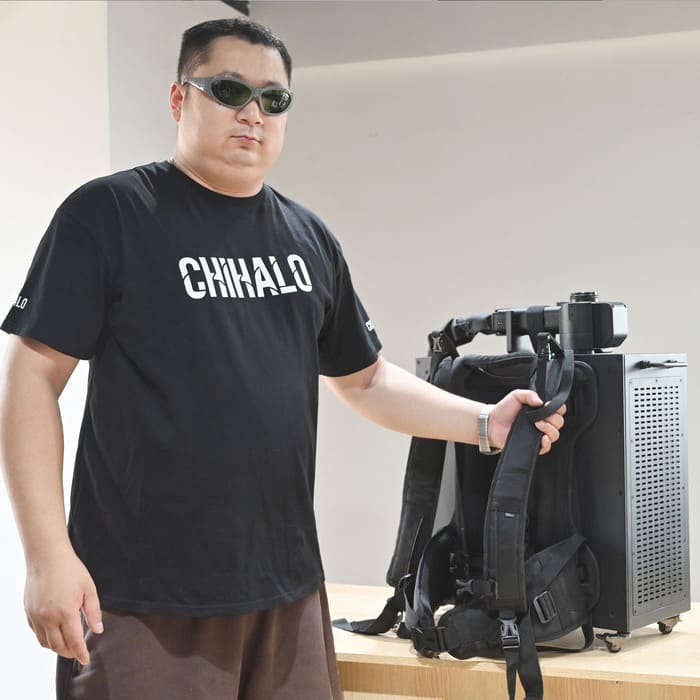
A wheeled power unit with a cable running to a handheld cleaning head. The operator points and cleans, similar to using a power washer. Weight of the handpiece runs 1-3 kg depending on power level.
Good for: Field service, varied part geometries, maintenance applications, small to medium volumes, facilities without automation infrastructure.
Automated Systems
Robot-mounted or gantry systems that clean parts automatically. Usually enclosed with fume extraction and interlocks.
Good for: High-volume production, consistent part geometries, unmanned operation, integration with existing production lines.

What Power Level Do You Need?
General guidelines from our testing:
- 50-100W: Light surface oxides, thin rust, small areas. Hobbyist and light commercial.
- 200-300W: Moderate rust, single-layer paint, general industrial. The “sweet spot” for most buyers.
- 500-1000W: Heavy rust, multi-layer paint, production speed requirements.
- 1000W+: High-volume industrial, thick coatings, maximum speed.
When in doubt, go higher. You can always turn down the power, but you can’t exceed your system’s maximum. The price difference between 200W and 300W is usually only 20-30%.
What Laser Cleaning Can't Do
Line of sight required. The laser has to see the surface. Inside tubes, deep holes, undercuts—anything the beam can’t reach, it can’t clean. This is the biggest limitation.
High upfront cost. A quality system costs more than sandblasting or chemical equipment. The ROI is usually good, but you need the capital or financing.
Thick coatings get slow. Laser cleaning works by removing thin layers with each pass. Coatings over 0.5mm thick require many passes. At some thickness, sandblasting becomes more practical.
Some materials are tricky. Materials that don’t absorb the laser wavelength well (like bare copper) are harder to clean. Reflective surfaces can require special optics or techniques.
Common Questions
Questions we hear regularly:
Not when set correctly. The ablation threshold for rust and paint sits well below the threshold for steel, aluminum, or other base metals. We've tested parts with 50+ cleaning cycles and seen no measurable material loss. That said, wrong settings can damage anything—that's why proper training matters.
Safer than most alternatives. No silica dust (silicosis kills thousands of sandblasters). No chemical fumes. The main risk is eye damage from direct beam exposure—addressed with proper eyewear and interlocks. Compared to the alternatives, laser is among the safest cleaning methods available.
Quality fiber lasers are rated for 50,000-100,000 hours. At typical usage of 2,000 hours per year, that's 25-50 years. The optics and cables may need occasional replacement, but the core laser source should outlast most other equipment in your shop.
Probably. Laser cleaning works on most metal substrates and many non-metals. The best answer is testing—any reputable supplier will do sample processing to confirm results before you buy.
Laser handles it but takes longer. Very heavy contamination (over 1mm) may require multiple passes and gets expensive per square foot. At some point, sandblasting followed by laser finishing makes more sense than laser alone.
Yes. Laser cleaning vaporizes contaminants. You need fume extraction at the cleaning point. Most systems come with or recommend specific extraction units. Don't skip this—you're removing stuff because it's bad, and you don't want it airborne in your facility.
Basic operation is straightforward—most people can run a handheld unit within an hour. Optimizing settings for different materials takes more experience. Budget 2-3 days for thorough training if you're doing varied work.
Major manufacturers typically offer 2-year warranties on the laser source and 1 year on other components. Extended warranties are usually available. Chinese imports vary widely—some offer good support, others are essentially "buy and hope."
If available in your area, yes. Some distributors and manufacturers offer rental programs. A week with the equipment tells you more than a hundred spec sheets.
More than any alternative. No chemicals to dispose of. No abrasive media going to landfill. Energy consumption is modest—a 200W system uses less power than a typical space heater. The only waste is the material you remove, which you'd have to deal with regardless of cleaning method.
Is Laser Cleaning Right for You?
A quick decision framework:
Laser cleaning probably makes sense if:
- You clean metal parts regularly—daily or weekly
- Surface quality or precision matters to your end product
- You want to eliminate chemicals from your process
- You’re spending significant money on blasting media or chemical disposal
- Your cleaning areas have clear line-of-sight access
Laser cleaning probably doesn’t make sense if:
- You only clean occasionally—a few times per year
- Your main cleaning need is internal surfaces (pipes, tubes)
- You’re removing very thick coatings (>2mm) over large areas
- Budget is under $15,000 and you can’t finance
Your Next Step: Start With a Free Consultation
Ready to explore whether a laser cleaning business is right for you?
What We Offer
- Assess your local market opportunity
- Recommend equipment for your target niche
- Review realistic revenue projections
- Answer your specific questions
- Entry-level to industrial systems
- Financing and leasing available
- Comprehensive training included
- 2-year warranty on all laser sources
Ongoing Support
- Technical assistance when you need it
- Marketing resources and templates
- Connection to our owner community
- Equipment service and maintenance