Laser Paint Stripping Machine: The Complete 2026 Buyer's Guide
Dawn Huang
I'm a passionate engineer and the founder of Chihalo Laser Factory. With an M.Sc. from HKU and 10 years in industrial laser field, I've mastered the laser craft from the ground up — from selecting parts to automating systems. Here, I translate complex industry updates into actionable knowledge. Join our community to stay ahead!
Table of Contents
Quick Definition: A laser paint stripping machine is an industrial device that uses high-intensity pulsed or continuous laser beams to remove paint, coatings, and surface contaminants from metal, wood, and other materials without damaging the underlying substrate. Prices range from $4,000 to $38,000+ depending on power level and brand.
Quick Answer: Is Laser Paint Stripping Right for You?
Short answer: Yes, if you remove paint frequently, need substrate protection, or face environmental regulations.
No, if it’s a one-time project or your budget is under $4,000.
✅ Laser Paint Removal Works Best When...
- You need to preserve the substrate (metal, wood, or composite materials)
- You perform paint removal frequently or continuously
- Environmental regulations restrict chemical use in your area
- You’re dealing with complex geometries that sandblasting can’t reach
- Worker safety is a priority (no toxic chemicals, minimal dust)
- You need precision—removing paint from specific areas while leaving others intact
❌ You Might NOT Need a Laser If...
- It’s a one-time project with a tight budget (consider renting or outsourcing)
- Surface damage doesn’t matter (sandblasting may be cheaper)
- You’re removing paint from extremely large flat surfaces where speed matters more
- Your budget is under $3,000 (entry-level lasers below this often underperform)
What Is a Laser Paint Stripping Machine and How Does It Work?
Definition: A laser paint stripping machine (also called laser paint remover or laser coating removal system) uses focused laser energy to vaporize paint and coatings through a process called laser ablation, leaving the underlying material intact.
The Science Behind Laser Paint Removal
Laser paint stripping works through three primary mechanisms:
- Thermal ablation: The laser heats the paint layer rapidly, causing it to vaporize before heat transfers to the substrate.
- Photomechanical effect: Short laser pulses create shockwaves that break the bond between paint and substrate.
- Photochemical decomposition: Laser energy breaks down the molecular structure of the coating.
Two Critical Thresholds
For effective paint removal without substrate damage, laser parameters must stay between two thresholds:
- Cleaning threshold: Minimum energy density needed to remove the paint
- Damage threshold: Energy level that would harm the underlying material
This is why proper machine selection matters—the right laser keeps energy between these thresholds automatically.
Pulsed vs. Continuous Wave Lasers
Feature | Pulsed Laser | Continuous Wave (CW) |
Energy delivery | Short, intense bursts | Constant beam |
Efficiency | 3-5x higher for paint removal | Lower efficiency |
Heat generation | Minimal substrate heating | Higher heat transfer |
Best for | Precision work, thin substrates, wood | Heavy rust, thick coatings |
Price | Higher ($8,000+) | Lower ($3,000+) |
Simple rule: Choose pulsed for precision and substrate protection.
Choose CW for heavy-duty cleaning where some heat is acceptable.
Real Pricing: What Laser Paint Stripping Machines Actually Cost in 2025
Quick Answer: Most buyers spend $8,000-$25,000 for a capable laser paint stripping machine.
Entry-level Chinese units start at $3,800; premium Western brands exceed $50,000.
Price Ranges by Power Level (2025 Market Data)
Power Level | Chinese Brands | Western Brands | Best For |
100-200W | $4,800 – $8,000 | $9,000 – $18,000 | Small repairs, precision, thin coatings |
300-500W | $9,000 – $12,000 | $18,000 – $24,000 | Medium industrial, auto body, furniture |
500-1000W | $16,000 – $38,000 | $35,000 – $55,000 | Heavy industrial, continuous production |
1500-3000W CW | $4,000 – $12,000 | $8,000 – $24,000+ | Shipyards, large-scale operations |
Note: Prices reflect FOB shipping. Add 15-25% for shipping, customs, and installation for international buyers.
Why the 40-60% Price Gap Between Chinese and Western Brands?
Chinese brands cost less because:
- Lower labor and manufacturing costs
- Domestic supply chain for laser sources (JPT, Raycus, MAX)
- Less marketing overhead
- Intense competition among 500+ manufacturers
Western brands charge more for:
- Local service networks in North America/Europe
- Comprehensive documentation and certifications
- Established brand reputation
- Faster support response times
Hidden Costs Most Sellers Won't Mention
Hidden Cost | Price Range | Notes |
Fume extraction system | $800 – $3,000 | Essential—laser vaporizes paint into fumes |
Safety equipment | $300 – $800 | Laser glasses, protective clothing, signage |
Shipping & customs | 15-25% | Sea: 4-6 weeks; Air: 3-4x more expensive |
Installation & training | $500 – $2,000 | Some include; others charge separately |
Annual maintenance | $200 – $500 | Protective lens replacement, calibration |
Electricity | $30 – $50/month | For 1000W running 8 hours/day |
Total budget rule: Add 30-40% to the machine price for a complete, operational setup.
Laser vs. Traditional Methods: Honest Comparison
Quick Answer: Laser beats sandblasting on precision and long-term cost.
Sandblasting wins on speed and upfront investment. Laser is always better than chemical stripping for safety and environmental compliance.
Laser vs. Sandblasting: Real Performance Data
Factor | Laser Paint Removal | Sandblasting |
Speed | 1-3 m²/hour | 3-8 m²/hour |
Surface Damage | None (non-contact) | Can damage soft metals |
Precision | Millimeter-level accuracy | Low precision |
Waste Generated | Minimal (fumes only) | Large amounts of media + dust |
Operating Cost/m² | $0.50 – $2.00 | $3.00 – $8.00 |
Initial Investment | $3,000 – $50,000+ | $500 – $5,000 |
ROI Timeline | 12-24 months | Immediate |
Bottom line: For high-value parts or frequent use, laser typically pays for itself within 12-24 months through lower operating costs and reduced rework.
When Laser is NOT the Best Choice
I sell laser machines, but I’ll be honest—laser isn’t always the answer:
- One-time large projects: Rent equipment or hire a service instead
- Extremely thick coatings (>5mm): Mechanical removal may be faster
- Highly reflective polished metals: Reduced efficiency due to reflection
- Very tight budgets with low volume: Extended ROI timeline
How to Choose the Right Laser Paint Stripping Machine
Quick Answer: Match power to coating thickness (100-200W for thin paint, 500W+ for industrial coatings), choose pulsed for precision work, and start with handheld configuration for maximum flexibility.
Step 1: Match Power to Your Coating Thickness
Coating Type | Thickness | Recommended Power | Speed |
Light rust, thin paint | < 0.1mm | 100-200W | 0.5-1.5 m²/hr |
Standard paint, medium rust | 0.1-0.5mm | 200-500W | 1-2 m²/hr |
Thick paint, heavy rust | 0.5-2mm | 500-1000W | 2-4 m²/hr |
Industrial/marine coatings | > 2mm | 1000W+ | 3-6 m²/hr |
Pro tip: When in doubt, go one power level higher. You can reduce power, but you can’t exceed maximum capacity.
Step 2: Select Your Configuration
Configuration | Best For | Price Range |
Handheld | Field repairs, varied workpieces, flexibility | $3,000 – $25,000 |
Fixed workstation | Production environments, consistent parts | $15,000 – $45,000 |
Robotic/Automated | High-volume production, 24/7 operation | $50,000 – $150,000+ |
Recommendation: 80% of buyers should start with handheld.
It offers maximum flexibility while you learn the technology.
Brand Comparison: Honest Industry Assessment
Quick Answer: Tier-1 Chinese manufacturers offer comparable technology at 40-60% lower cost. Western brands justify premium pricing through local service and documentation.
Avoid trading companies.
Chinese Manufacturer Tiers
Tier | Characteristics | Price Range | Risk |
Tier 1 | Established QC, reputable laser sources, meaningful warranties | $5,000-$25,000 | Low |
Tier 2 | Variable quality, limited support, may cut corners | $2,500-$8,000 | Medium |
Tier 3 | Trading companies, no manufacturing, no accountability | $1,500-$4,000 | High |
🚩 Red Flags When Evaluating Suppliers
- Inflated power claims: “2000W” for $3,000? The laser source alone costs more.
- No video demonstrations: No proof the machine actually works.
- Vague component details: Should specify exact laser source brand.
- No factory address: Legitimate manufacturers welcome video tours.
- Prices too good to be true: Quality components have floor prices.
- Personal account payments: Legitimate businesses use standard trade terms.
Applications: Real Results by Industry
Automotive: Paint Stripping and Restoration
Common applications: Body panel preparation, classic car restoration, selective paint removal for welding prep
Typical setup: 300-500W handheld pulsed laser
ROI for busy body shops: 8-14 months
Case Study: A California auto restoration shop switched from chemical stripping to a 500W pulsed laser.
Results: 60% faster turnaround, zero hazardous waste disposal costs, and $18,000 annual savings in chemicals and labor.
Wood and Furniture Restoration
Critical requirements:
- Must use pulsed laser (CW will scorch wood)
- Lower power settings (100-300W)
- Multiple passes at reduced intensity
Case Study: A UK furniture restoration company uses a 200W pulsed laser for antique pieces.
They report 40% time savings compared to manual sanding and ability to preserve original patina.
Buying from China: Complete Sourcing Guide
Quick Answer: Verify manufacturer legitimacy through business license checks, video factory tours, and customer references.
Avoid trading companies.
Always test with your materials before purchasing.
How to Verify a Chinese Supplier
- Check business registration: Request license, verify on National Enterprise Credit Information System
- Video factory tour: Legitimate manufacturers do live video calls showing production
- Customer references: Ask for contacts of previous international buyers
- Component documentation: Require proof of laser source brand (JPT, Raycus, IPG)
- Sample testing: Send your materials for them to process; review video results
Common Mistakes to Avoid
- Choosing on price alone: Cheapest quote often uses inferior components
- Ignoring voltage: Specify 110V/220V/380V before ordering
- Skipping inspection: Always inspect before shipping
- Unclear warranty: Get details in writing
- No spare parts: Order critical spares with the machine
Recommended Laser Paint Stripping Machines
Best for Small Workshops & Beginners
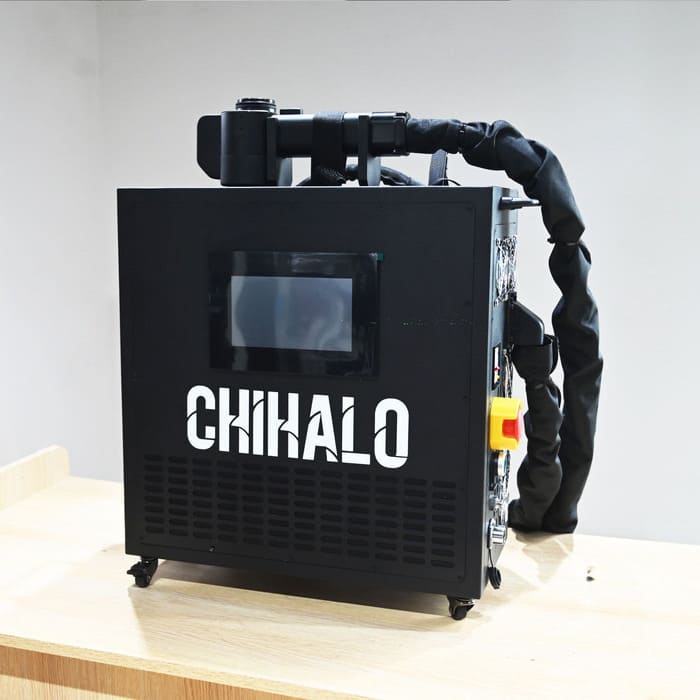
Chihalo CHL-M200 Handheld Pulsed Laser Cleaner
- Power: 200W pulsed fiber laser
- Laser source: JPT (100,000+ hour lifespan)
- Best for: Auto body shops, furniture restoration, maintenance
- Price range: $5,500 – $9,000
- Includes: Handheld gun, 5-15m fiber cable, safety glasses, basic training
Best Value for Industrial Use
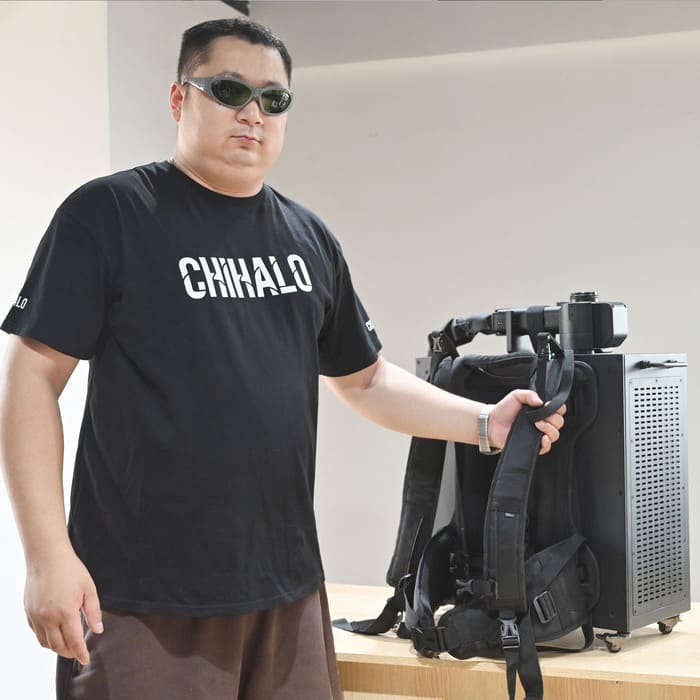
Chihalo CHL-M500 Industrial Laser Cleaning System
- Power: 500W pulsed fiber laser
- Laser source: Raycus or JPT (customer choice)
- Best for: Manufacturing, production environments, heavy coatings
- Price range: $15,000 – $20,000
- Includes: Handheld gun, workstation option, fume extraction port, full training
Quick Selection Guide
Your Situation | Recommended Model | Budget |
Occasional use, thin coatings | CHL-M100 | $4,500 – $6,500 |
Regular use, mixed coatings | CHL-M200 | $7,500 – $9,000 |
Daily production, standard coatings | CHL-M500 | $15,000 – $18,000 |
Heavy industrial, thick coatings | CHL-P1000 | $5,000 – $8,000 |
Continuous operation, marine/shipyard | CHL-P3000 | $9,000 – $12,000 |
Frequently Asked Questions
Short answer: $2,800 to $100,000+, with most buyers spending $8,000-$25,000.
Entry-level 100W Chinese units start around $2,800. Mid-range 300-500W machines cost $6,000-$15,000. Premium Western brands exceed $50,000. Budget an additional 30-40% for accessories and installation.
Short answer: 100-200W for thin coatings, 300-500W for standard paint, 500-1000W for heavy industrial, 1000W+ for marine.
Match power to your thickest coating. When uncertain, choose one power level higher—you can always reduce power.
Short answer: Yes, but only with pulsed lasers and proper settings.
Use 100-300W pulsed lasers at reduced power with multiple passes. Continuous wave lasers will scorch wood.
Short answer: Better for precision and substrate protection; sandblasting is faster and cheaper upfront.
For high-value parts or frequent use, laser typically pays for itself in 12-24 months.
Short answer: Pulsed is better for most applications; CW is cheaper for heavy-duty work.
Pulsed lasers are 3-5x more efficient and generate less heat, ideal for precision work.
Short answer: Laser safety glasses, fume extraction, protective clothing, warning signage. Budget $1,000-$4,000.
Never operate without proper safety equipment.
Short answer: Chinese for value; Western for local support and regulated industries.
Chinese brands offer 40-60% savings with comparable core technology.
Short answer: 10+ years for quality machines.
Fiber laser sources are rated for 100,000+ hours—over 10 years of continuous operation.
Conclusion: Making Your Decision
Choosing a laser paint stripping machine is a significant investment. Here’s my summary advice:
- Match power to your heaviest application—excess capacity is better than struggling.
- Choose pulsed for precision, CW for heavy-duty—when uncertain, pulsed is more versatile.
- Start with handheld—80% of applications are well-served by handheld systems.
- Budget for the complete system—fume extraction, safety equipment, and training are mandatory.
- Verify before buying—request demonstrations, check references, understand warranty terms.
Whether you buy from Chihalo or another supplier, I hope this guide helps you make an informed decision.
The right laser paint stripping machine can transform your operation.
Send us your coating samples, and we’ll provide video demonstrations of actual results—no obligation, no pressure. We’d rather help you find the right solution than sell you the wrong machine.
Laser Cleaning Cost Per Hour: What We’ve Learned from 500+ Projects DC
ost Per Hour: What We’ve Learned from 50 ost Per Hour: What We’ve Learned from 50 Laser Cleaning Cost Per […]
Precision Laser Cleaning
Precision Laser Cleaning Table of Contents What Is Precision Laser Cleaning? If you’ve ever struggled with rust removal, paint stripping, […]
Laser Wood Stain Remover: Does It Really Work? A Complete Guide with Real Results
Laser Wood Stain Remover: Does It Really Work? A Complete Guide with Real Results Table of Contents Last Updated: January […]