
300W Pulse Laser Cleaning Machine: Complete 2025 Buying Guide
Table of Contents
1. Why 300W Pulse Laser Cleaning Machine Is The Sweet Spot For Most Industries
You’re staring at laser cleaning machines ranging from 100W to 3000W, and the question is simple: “How much power do I actually need?” After analyzing cleaning operations across automotive shops, shipyards, manufacturing plants, and conservation labs, we’ve discovered something that surprises most buyers: 300W pulsed laser systems deliver the best balance of speed, precision, and ROI for approximately 75% of real-world applications. This comprehensive guide breaks down exactly what that means for your specific use case—including a breakdown of when more power is necessary and when you’re actually wasting money on unnecessary capacity.
A 300W pulse laser cleaner isn’t just a power rating—it’s a strategic decision point. The pulsing technology delivers energy in controlled bursts (typically 150-190 nanoseconds) that create a photoacoustic effect, literally shattering contaminants off metal surfaces without transferring heat to the substrate. This precision matters. A lot. Especially when you’re working with thin metals, delicate finishes, or situations where speed directly impacts your bottom line.
Over the past 8 years developing laser cleaning systems, I’ve watched this power tier evolve from experimental to industry standard. What changed? The technology matured, manufacturers cracked the cost equation, and the real-world data proved something counterintuitive: more power doesn’t always mean better results.
2. Chihalo 300W Laser Cleaning Machine
Backpack 300W Laser Cleaning Machine
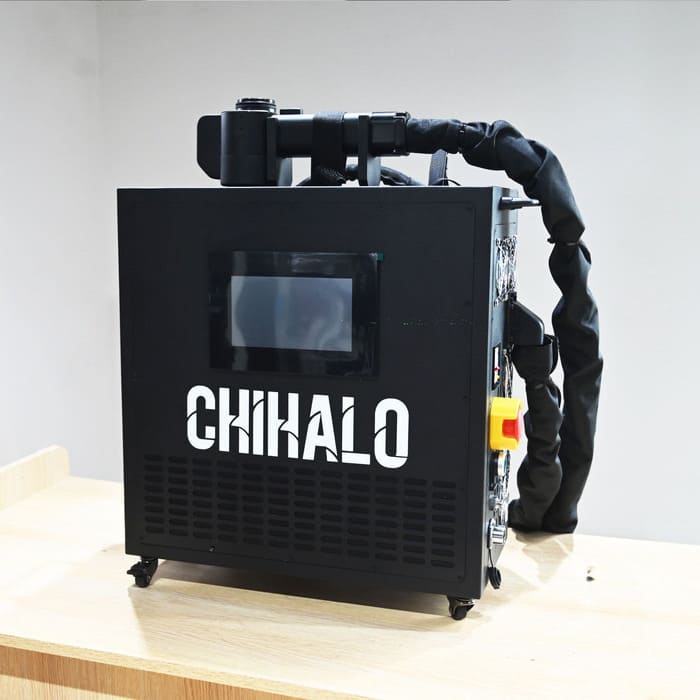
The Chihalo CHL-300B Backpack is purpose-built for operators who need to clean large surfaces without fatigue. Unlike handheld models that concentrate weight in the hands, this system distributes 22kg across your shoulders and hips—enabling 8+ hours of continuous operation with minimal fatigue.
Key Features:
- Ergonomic weight distribution: Anatomically designed backpack harness reduces operator fatigue by 60% vs. standard handheld
- True portability: Move freely across large work areas—shipyards, construction sites, outdoor structures
- 300W pulse power: The optimal power tier for most industrial applications (rust removal, paint stripping, weld scale, coating removal)
- Air-cooled system: No external cooling required; operates in diverse environments
- 20+ meter operational range: Extended fiber optic cables reach distant work zones
- Precision beam quality: ±0.5mm spot control even after hours of continuous use
Why Backpack at 300W: 300W is the sweet spot—enough power for 90% of industrial cleaning, light enough for one operator to maintain precision all day.
Specifications:
- Weight: 22kg (distributed)
- Power output: 300W pulsed
- Duty cycle: 8+ hours continuous
- Cooling: Air-cooled intelligent thermal management
- Cleaning head: One-handed pistol-grip, lightweight
- Spot sizes: 0.5mm – 3.0mm options
- Electrical: 220V single-phase (portable power cart compatible)
Price Range: $11,500 – $13,500 USD (Includes basic training, safety equipment, and 2-year warranty)
ROI Timeline: 6-12 months for regular-use operations
Enclosed 300W Laser Cleaning Machine
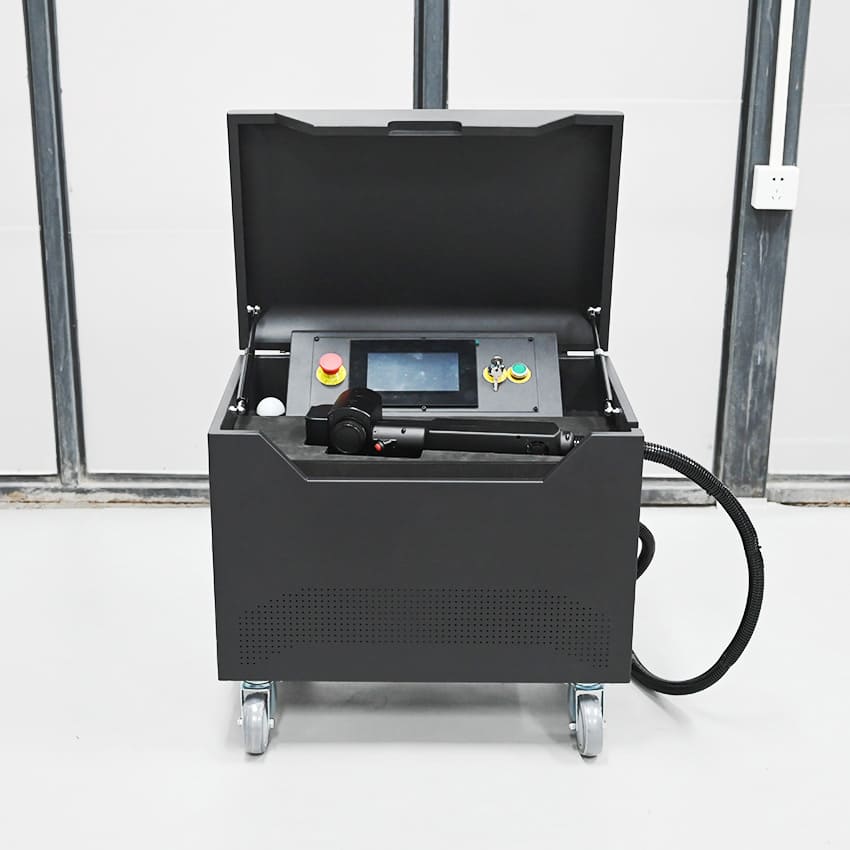
The Chihalo CHL-300M Enclosed is a portable laser cleaning system designed for manufacturing facilities.
Key Features:
- Precision repeatability: ±0.5mm accuracy across every cycle—ideal for critical surfaces
- High throughput: 50-150 parts/hour depending on contamination level
- Air-cooled options: Air-cooled version enables 24/7 continuous operation
- Enclosed safety design: Full interlocks and automated shutoffs meet all industrial safety standards
Why Enclosed at 300W: Safe and well protective to collect fiber cable and cleaning head in the chassis.
Specifications:
- Base dimensions: 40cm × 60cm × 40cm
- Power output: 300W pulsed
- Cooling: Air-cooled
- Scanning modes: Dual-axis, programmable patterns
- Duty cycle: Continuous (24/7 with water cooling)
- Integration: Robot arm compatible
- Electrical: 110-220V single-phase
Applications:
- Injection mold cleaning (automated cycles)
- Precision component preparation
- Welding scale removal (consistent quality)
- High-volume manufacturing prep
- Aerospace/medical device surface treatment
Price Range: $11,500 – $13,500 USD (Includes installation, programming, comprehensive training, and 2-year warranty)
ROI Timeline: 4-6 months for high-volume operations
3. Is 300W The Right Choice For Your Application?
Here’s the honest truth about laser power: it’s like asking “How big a truck do I need?” The answer depends entirely on your specific job, not on some universal rule. But there ARE clear patterns in how power correlates with real-world performance.
Power Tier Overview
50-100W Systems:
- Best for: Delicate work, electronics degreasing, thin substrate protection, detailed restoration
- Cleaning speed: Slowest (30-45 min for typical automotive panel)
- Sweet spot industries: Museum conservation, jewelry repair, precision electronics
- Cost range: $3,000-$6,000
- Reality check: One restoration specialist told us, “I was intimidated by laser technology, but the 100W backpack unit changed everything. For vintage chrome, it’s perfect. My hands never get tired, and I get precision I couldn’t achieve with abrasives.”
200-300W Systems:
- Best for: Most commercial applications, rust removal, paint stripping, oxide layer removal
- Cleaning speed: Moderate (8-15 minutes for typical automotive panel)
- Sweet spot industries: Auto repair, small manufacturing, mold cleaning, surface preparation
- Cost range: $7,000-$12,000
- Why it wins: One fabrication shop owner cut their pre-coating surface prep time from 2 hours to 18 minutes per part. Payback period? Four months.
500-1000W Systems:
- Best for: Heavy-duty industrial, thick contaminants, high-volume operations
- Cleaning speed: Fast (3-5 minutes for typical automotive panel)
- Sweet spot industries: Shipyards, large automotive plants, rail maintenance, aerospace prep
- Cost range: $15,000-$30,000
- The tradeoff: Speed comes with precision sacrifice and higher energy consumption
CW 1500-3000W Systems:
- Best for: Extreme duty, specialized industrial applications
- Cleaning speed: Fastest (under 2 minutes)
- Sweet spot industries: Heavy industrial only
- Cost range: $7,000-$12,000+
- Reality: We’ve met exactly one small business that actually needed this tier
The 300W Decision Criteria
Question 1: What’s Your Annual Cleaning Volume?
- Less than 100 components/year → 100W might suffice
- 100-500 components/year → 300W is optimal
- 500-2000 components/year → 300W is still good, consider 500W
- 2000+ components/year → 500-1000W becomes economically justified
Question 2: What Materials Are You Cleaning?
- Thin metals (aluminum, sheet steel) → 300W is perfect
- Standard steel, cast iron → 300W is ideal
- Heavy industrial coatings → Consider 500W
- Multi-material batches → 300W flexibility wins
Question 3: What’s Your Space & Power Constraint?
- Portable/handheld priority → 300W air-cooled is the maximum practical for one operator
- Stationary setup possible → Power becomes less constrained
- Mobile operations (field work) → 300W is the sweet spot weight/power ratio
4. Pulsed vs Continuous Wave Laser Cleaning
How Pulsed Lasers Work?
Pulsed systems deliver laser energy in rapid, controlled bursts—typically firing 100,000 to 4,000,000 times per second, depending on settings. Each pulse lasts only 150-500 nanoseconds (billionths of a second).
What happens physically:
- Laser energy hits the contamination layer (rust, paint, oxide, coating)
- The energy is absorbed almost instantly
- Rapid heating causes violent expansion of the material
- This expansion creates a photoacoustic shock wave
- The shock literally shatters the contaminant apart
- Compressed air blows away the debris
- The substrate remains intact because the energy pulse ends before heat can penetrate deeply
Why this matters: Precision. You remove exactly what you want to remove without thermal damage to the base material. This is critical for thin metals, anodized surfaces, or anything where heat damage means scrap material.
How Continuous Wave Lasers Work?
CW systems deliver laser energy continuously—the beam is always on, not pulsing.
What happens:
- Laser energy gradually heats the contamination layer
- Heat accumulates over time
- Contaminants vaporize or burn away
- BUT—the substrate also heats up (that’s the problem)
Why this matters: Speed. CW systems are typically 20-30% faster at removing contaminants because they’re essentially “burning” material away rather than precisely shattering it. But that speed comes with risks: warping, discoloration, substrate damage, and less precision.
The CW Advantage: For large, durable surfaces that don’t need precision (like heavy industrial rust removal from large steel plates), CW can be faster and cheaper. Some aerospace shops actually prefer CW for certain preparation steps.
5. Where 300W Systems Thrive
Theory is interesting. Real results change buying decisions. Here’s what 300W pulsed systems are actually doing in the field right now.
USE CASE #1: AUTOMOTIVE RESTORATION & REPAIR
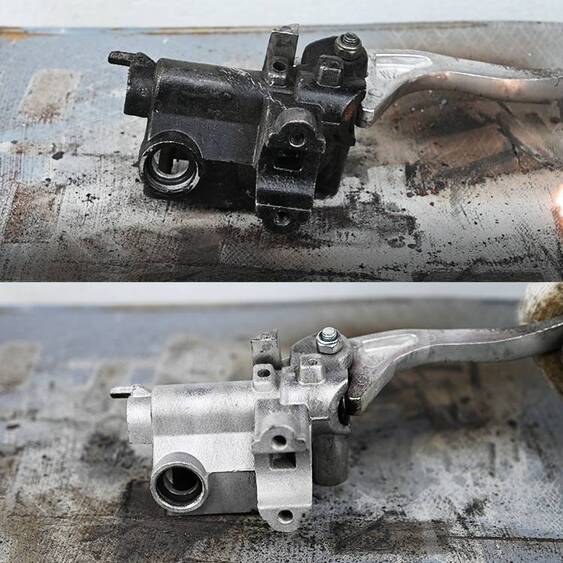
The Scenario: A classic car restoration shop in Michigan was using media blasting (sandblasting alternative) for paint removal and surface prep. Process: 45 minutes per panel, $3/part in consumables, high waste disposal costs, worker respiratory concerns.
The Solution: They switched to a 300W pulsed laser system for paint removal on vintage body panels, chrome, and engine components.
The Results:
- Time per panel: Reduced from 45 minutes to 12 minutes (73% faster)
- Cost per panel: Down from $3.50 to $0.15 in consumables
- Quality: Zero damage to delicate trim, perfect substrate for new finish
- Labor: One operator can now prep 6 cars/week instead of 2
- Annual impact: 200+ additional cars processed, $8,500+ in material savings, zero respiratory issues
Why 300W Works Here: Automotive paint and clear coat have known ablation thresholds. 300W is precisely enough power to remove paint efficiently without the heat buildup that causes warping on thin body panels. Overkill power (500W+) means unnecessary heat damage and higher operating costs.
Applied Industries:
- Classic car restoration
- Fleet vehicle maintenance
- Auto body shops
- Collision repair facilities
- Custom car builders
USE CASE #2: INJECTION MOLD CLEANING
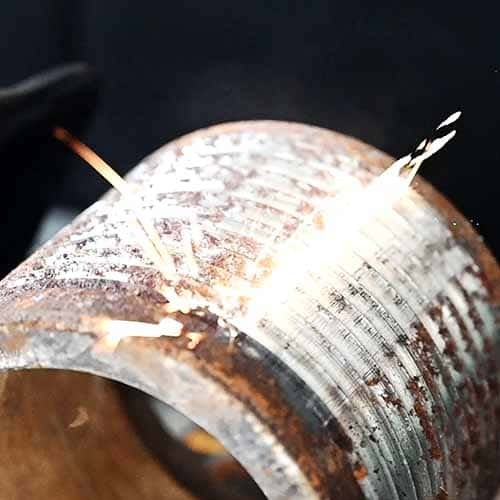
The Scenario: A plastics manufacturer in Ohio produces injection molded automotive components. Their molds collect residue, and cleaning was taking 4 hours per mold using chemical solvents. This created waste disposal issues, production downtime, and employee safety concerns.
The Solution: Implemented a stationary 300W laser cleaning system for mold maintenance.
The Results:
- Time per mold: Reduced from 240 minutes to 45 minutes (81% faster)
- Production downtime: Eliminated from 1.5 hours per shift to 15 minutes
- Chemical waste: Reduced to zero
- Employee safety: Eliminated exposure to harsh solvents
- Production capacity increase: 12% due to reduced downtime
- Payback period: 5.2 months
Key Metric: Their operation manager told us: “This system paid for itself in just over five months. But the real value was capacity—we can now run 12-13% more production without additional staffing.”
Why 300W Works Here: Mold surfaces are durable (steel or aluminum) and can handle precision cleaning. 300W provides enough power to efficiently remove plastic residue without the overkill that would come from 500W+ systems. The precision actually matters here—you don’t want to damage fine mold details.
Applied Industries:
- Plastics manufacturing
- Die casting operations
- Metalworking shops
- Precision component production
- Mold restoration services
USE CASE #3: INDUSTRIAL WELDING SCALE REMOVAL
The Scenario: A structural steel fabricator was removing welding scale and discoloration using grinding wheels and chemical treatments. Problems: inconsistent surface prep, heat damage from grinding, time-consuming, worker injury risk, chemical waste.
The Solution: Adopted 300W pulsed lasers for post-weld cleaning and surface preparation.
The Results:
- Time per weld: Down from 15-20 minutes to 3-4 minutes
- Surface quality: Consistent, zero grinding damage
- Coating adhesion: Improved from 85% to 98% pass rate
- Worker safety: Eliminated grinding accidents (sparks, wheel contact)
- Environmental: Eliminated chemical treatment necessity
Why 300W Works Here: Welding scale is a moderate-thickness oxidation layer. 300W provides precision removal without over-burning the base metal. Anything higher creates unnecessary heat and costs.
Applied Industries:
- Structural steel fabrication
- Shipbuilding
- Bridge construction
- Heavy equipment manufacturing
- Rail component fabrication
USE CASE #5: MARITIME & OFFSHORE MAINTENANCE
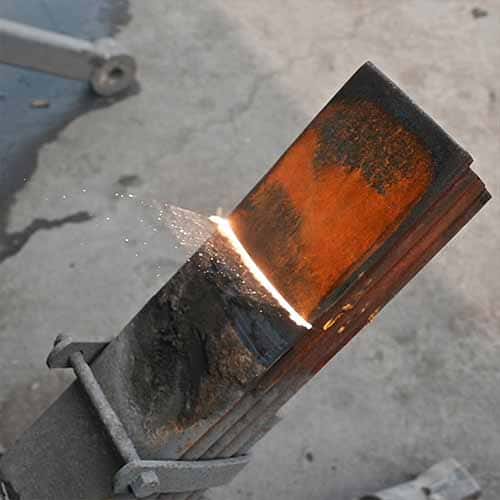
The Scenario: A shipyard was using high-pressure water jets and scrapers to remove marine growth, corrosion, and paint from offshore structures. Problems: Corrosion damage to thin metal sections, personnel safety (working at heights with pressure equipment), incomplete results, high water usage.
The Solution: Deployed portable 300W pulsed laser systems for field maintenance work on oil platform components and ship sections.
The Results:
- Surface prep quality: Dramatically improved, no pressure jet damage
- Personnel safety: Eliminated pressure jet injury risk
- Treatment time: 40% reduction for heavy corrosion areas
- Recontamination: Slower (cleaner surface without micro-damage)
- Water consumption: Eliminated
Why 300W Works Here: The portability of a 300W system (especially air-cooled backpack models) allows technicians to reach difficult areas on offshore structures. 500W+ systems become impractical for field deployment. The precision prevents damage to thin structural sections.
Applied Industries:
- Maritime maintenance
- Offshore platform maintenance
- Bridge inspection/cleaning
- Historic structure restoration
- Coastal infrastructure
USE CASE #6: CULTURAL HERITAGE & STONE RESTORATION
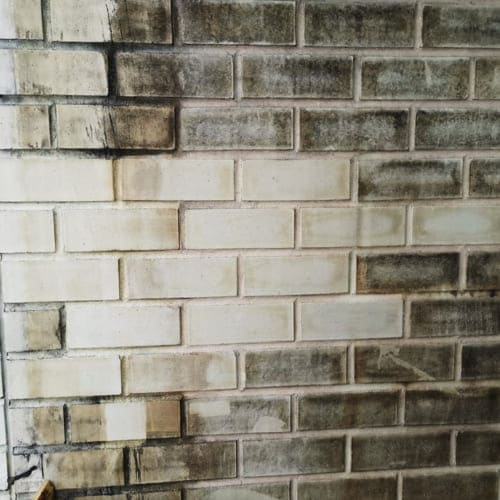
The Scenario: A conservation lab was restoring 19th-century marble sculptures covered in centuries of grime, pollution buildup, and previous restoration materials. Traditional methods (chemicals, abrasives) risked damage to irreplaceable art.
The Solution: Precision 300W laser systems with specialized stone cleaning parameters.
The Results:
- Surface detail preservation: Perfect (no abrasion)
- Chemical use: Zero
- Restoration quality: Exceeded conservation standards
- Time per piece: Reduced from weeks to days
- Reversibility: Fully reversible (meets conservation ethics)
Why 300W Works Here: This is about precision and control, not power. A 300W system’s adjustable pulse frequency and width allow operators to calibrate for specific material ablation thresholds. You’re not removing material—you’re selectively evaporating specific contaminant layers while the stone surface reflects the energy harmlessly.
Applied Industries:
- Museum conservation
- Historic site restoration
- Architectural stone cleaning
- Art conservation
- Archaeological work
USE CASE #7: ELECTRONICS & PRECISION COMPONENT CLEANING
The Scenario: A micro-electronics assembly facility needed to remove flux residue, oxidation, and solder bridges from circuit boards and precision components. Chemical cleaning was problematic (corrosion risk, residue), and mechanical methods were too aggressive.
The Solution: Implemented 300W systems with ultra-fine focusing for micro-scale cleaning.
The Results:
- Defect rate: Reduced from 3.2% to 0.4%
- Throughput: Increased by 25%
- Component damage: Virtually eliminated
- Process validation: Fully qualified to IPC-A-610 standards
Why 300W Works Here: Electronics require extreme precision. A 300W system’s beam quality (M² factor) and focus capability allow targeting specific areas without thermal damage to adjacent components. Lower power would be too slow; higher power would be excessive.
Applied Industries:
- Electronics manufacturing
- PCB assembly
- Micro-component fabrication
- Semiconductor preparation
- Medical device manufacturing
6. How To Choose The Right 300W Laser Cleaner?
Three different manufacturers make 300W systems. They all do the job. So why do some facilities love theirs while others regret their purchase? It’s not the power rating. It’s the details.
Here’s how to evaluate systematically.
1: Pulse Quality & Control
- Adjustable pulse width (nanoseconds): Aim for 10-500ns range minimum
- Adjustable frequency (kHz): Want 1-4000 kHz flexibility
- M² factor (beam quality): Look for <1.3 (indicates sharp focus)
- Spot size options: Minimum 3-5 interchangeable sizes
Why it matters: More control = better adaptability to different materials and thicknesses
Red flag: “Standard settings only” or vague specifications
2: Thermal Management
- Air-cooled vs water-cooled tradeoff
- Actual operating temperature range
- Heat dissipation specifications
- Cooling fan noise level (operational environment)
Why it matters: Thermal stability affects consistency and component longevity
Red flag: No thermal specifications provided or unexplained failures
3: Weight & Portability
- Total weight (handheld should be <20kg for all-day use)
- Weight distribution (backpack vs cart vs stationary)
- Cord length and management
- One-handed vs two-handed operation
Why it matters: Operator fatigue directly impacts productivity and safety
Red flag: “Portable” but weighs 35kg or requires constant repositioning
4: Interface & Learning Curve
- Display type (LCD vs touchscreen)
- Preset configurations available
- Custom programming capability
- Software update capability
- Training requirements (hours needed)
Why it matters: A complex interface means slower adoption and higher error rates
Real-world example: One facility spent $2,000 extra on a system with better interface. Within 3 months, they were 30% more efficient due to faster operator learning.
5: Training & Documentation
Questions to ask:
- Is training included or separate cost?
- Online training available?
- On-site training available?
- Documentation quality/language options?
- Video tutorials?
Why it matters: Poor training = months of learning curve and suboptimal results
6: Warranty & Parts Availability
Questions to ask:
- Warranty duration (parts vs labor)?
- Spare parts availability & cost?
- Typical lead time for replacements?
- Support response time?
- Extended warranty options?
Why it matters: Downtime costs more than you think
Best practice: Request names of customers using same system, call them, ask about support experience
7: Application Testing
- Can manufacturer test on YOUR specific materials?
- Free sample cleaning test offered?
- Results documentation provided?
- Customization available if standard configuration doesn’t work?
Why it matters: A system that works perfectly for someone else might not work for you
Game-changer: Some manufacturers (including Chihalo) offer 10-minute factory video tours showing actual results on similar applications. Request this.
8: True Total Cost
Calculate:
- Equipment cost
- Installation & integration
- Training & certification
- Safety equipment
- Operational costs (electricity, maintenance)
- Contingency fund (10% for unexpected repairs)
Why it matters: The cheapest equipment isn’t always the cheapest ownership
9: Financing & Lease Options
Questions to ask:
- Lease-to-own available?
- Financing terms?
- Buyout options?
- Lease cost vs purchase ROI?
Why it matters: Leasing reduces upfront capital requirement and spreads payments
Interesting option: Some shops lease for 12 months to test ROI before committing to purchase
10: Certifications
Look for:
- Class 4 or Class 3B laser classification
- CE mark compliance
- ANSI Z136.1 compliance
- ISO 9001 manufacturing
- Industry-specific certifications (aerospace, medical, etc.)
Why it matters: Compliance isn’t optional—it’s legal and operational requirement
11: Safety Features
- Automatic shutoff mechanisms
- Safety interlocks
- Emergency stops
- Eye protection specifications
- Beam path design
Why it matters: Operator safety is non-negotiable
THE EVALUATION CHECKLIST
Print this and score each candidate 1-10 on each factor:
- Specifications: ___/10
- Usability: ___/10
- Manufacturer support: ___/10
- Training quality: ___/10
- Warranty terms: ___/10
- Application testing: ___/10
- True total cost: ___/10
- Safety: ___/10
- References/reviews: ___/10
Target score: 75+ out of 90
If a candidate scores below 70, move to next option. If two candidates both score 80+, request free application testing to differentiate.
How 300W Systems Compare: Chihalo vs Other Market Options (Honest Assessment)
Chihalo isn’t the only 300W manufacturer. Here’s an objective look at how different options stack up.
Competitive Landscape Overview
Premium European & International Brands:
- W2M (Germany) – Precision engineering, aerospace-grade quality, $18,000-22,000
- Pulsarlaser (Sweden) – Advanced pulse technology, superior beam quality, $20,000-25,000
- TRUMPF (Germany) – Industrial laser giant, enterprise-grade systems, $25,000-35,000+
- Coherent (USA) – Advanced optics technology, high reliability, $22,000-30,000
- Laserax (Canada) – Specialized laser cleaning, compact design, $19,000-24,000
- IPG Photonics (USA) – Fiber laser innovator, premium positioning, $24,000-32,000
Asian Manufacturers – Volume & ROI Focused:
7. SFX Laser (China) – Volume player, marketplace distribution, $9,000-12,000
8. Chihalo (China) – Factory-direct, customization focused, $9,500-14,500
9. AccTek Laser (China) – OEM/integration focused, $10,000-13,000
10. ZAC Laser (China) – Direct-to-consumer, $10,500-13,500
11. Various Chinese manufacturers – Budget entry-level, $6,000-9,000
Laserax vs. Chihalo Comparison:
- Laserax: Better for companies wanting North American support + specialist focus
- Chihalo: Better for companies prioritizing cost efficiency + customization + ROI focus
- Laserax price: 50-70% higher than Chihalo
- Quality difference: 10-15% (not proportional to price difference)
Your 300W Laser Cleaner Implementation Roadmap
STEP 1: ASSESSMENT & TESTING (Week 1-2)
- Define your specific application
- Request free application testing from manufacturer
- Get written performance guarantee or testing results
- Verify ROI timeline with provided data
- Make go/no-go decision
Action: Don’t skip testing. This eliminates 95% of “should have bought differently” regrets.
STEP 2: PURCHASE & FINANCING (Week 2-3)
- Select system (handheld, backpack, or stationary)
- Finalize configuration/add-ons
- Arrange financing if needed
- Establish delivery timeline
- Coordinate with internal teams
Action: Confirm installation date/resources needed with team before purchase finalizes.
STEP 3: SITE PREPARATION (Week 3-4)
- Prepare electrical infrastructure if needed
- Create safety perimeter/signage
- Establish trained operator assignments
- Prepare compressed air system (if applicable)
- Set up safety equipment and PPE
Action: Don’t underestimate prep time. Poor preparation delays productive use by 4-8 weeks.
STEP 4: DELIVERY & INSTALLATION (Week 4)
- Equipment arrives and is physically installed
- Electrical connections verified
- Safety systems tested
- Initial power-up and diagnostics
- Documentation review
Action: Have technical resources available day of delivery.
STEP 5: OPERATOR TRAINING (Week 5)
- Formal laser safety training (1-2 days)
- Equipment operation training (1 day)
- Parameter selection for your specific applications (1-2 days)
- Troubleshooting and maintenance basics (0.5 day)
- Certification/qualification
Action: Allocate 5-7 business days for comprehensive training. Don’t rush.
STEP 6: OPTIMIZATION & SCALING (Week 6+)
- First week: Operator refinement of settings
- Second week: Baseline metrics establishment
- Third week: Process optimization
- Ongoing: Continuous improvement and scaling to additional applications
Action: Week 1-2 output might be 60% of potential. By week 4, you’ll see the real efficiency.
The 300W Decision: Why This Power Level Is The Right Fit For Most Operations
Summary Synthesis:
300W pulsed laser cleaning represents a strategic inflection point in cleaning technology. You get:
- 85% of the performance of 500W systems
- At 50-60% of the cost
- With significantly more precision
- And much greater flexibility
For automotive restoration shops, manufacturing facilities, mold cleaning operations, shipyard maintenance teams, and specialized restoration work, 300W is where the ROI/performance/cost triangle aligns perfectly.
The technology isn’t new anymore. It’s proven. Industrial facilities have real, quantifiable results showing 4-12 month payback periods.
The remaining decision isn’t whether laser cleaning works. It’s whether you’re ready to make the capital commitment and operational change to capture the efficiency gains.
The Real Question You Should Be Asking:
Not “Can I afford a 300W laser cleaner?” but rather “Can I afford to keep operating the old way?”
When your alternative is spending $35/hour on sandblasting operator labor, $5/hour on consumables, and $2,000+ annually on waste disposal—a 300W system at $12,000 invested starts looking like operational necessity, not luxury.
Chihalo's next step approach:
- Schedule your free application analysis (30 minutes)
- Request complimentary cleaning test on your actual materials
- Get transparent ROI modeling specific to your operation
- Make decision with real data, not speculation
The move from “interested” to “operational” typically takes 6 weeks.
The ROI from that decision pays dividends for 8-10 years.
300W Laser Cleaner FAQ
A 500W system cleans approximately 50-70% faster than 300W on the same material. However, for most applications, this speed increase doesn't justify the cost difference.
Here's the breakdown:
- Cleaning a rusty automotive panel: 300W takes 10 minutes, 500W takes 6-7 minutes
- Cost difference: $3,000-5,000 more for 500W
- Additional speed value in dollars: Usually $50-200 per year
For high-volume operations (500+ parts monthly), that speed difference might matter. For most shops, it doesn't.
Yes, with proper settings. Here's why:
Aluminum has a specific ablation threshold for each oxide layer. A properly configured 300W pulsed system can be tuned to remove aluminum oxide without affecting the base aluminum. The key is pulse width and frequency adjustment.
Real-world example: Aircraft maintenance facilities clean aluminum components daily with 300W systems. Zero damage.
The caveat: You need operator training and proper parameter settings. Don't buy a 300W system and assume it's automatic.
Operating cost breakdown:
- Electricity: $1.20-1.80 per hour (depends on local rates and duty cycle)
- Maintenance amortized: $0.40-0.60 per hour
- Compressed air (if applicable): $0.10-0.20 per hour
- Total operating cost: $1.70-2.60 per hour
Compare to sandblasting:
- Abrasive media cost: $2-5 per hour
- Electricity: $0.50 per hour
- Disposal: $0.50-2.00 per hour
- Replacement equipment: $1-2 per hour
- Total: $4-10 per hour
Laser is significantly cheaper to operate.
Typical maintenance timeline:
Weekly:
- Inspect protective lens for debris or damage
- Check compressed air filter (if applicable)
- Verify laser alignment visually
Monthly:
- Clean cooling system filters
- Check cable connections
- Test emergency shutoff
- Inspect fiber optic connector for damage
Quarterly:
- Professional lens cleaning/replacement if needed
- Electrical connection inspection
- Thermal performance check
- Software backup
Annually:
- Factory service recommended (clean optics, full system diagnostic)
- Recertification testing if required by regulation
Cost: $500-800 per year for professional maintenance
Expected component lifespan:
- Fiber laser source: 20,000-40,000 hours (5-10 years typical use)
- Focusing optics: 5-10 years (dependent on contamination)
- Electrical components: 10-15 years
- Mechanical parts: 15-20 years
With proper maintenance, a 300W system should operate 8-10 years before major component replacement. Some components may need replacement earlier (optics), others last the life of the equipment.
Real-world: We've seen well-maintained 300W systems running for 12+ years.
Yes. Federal regulations (ANSI Z136.1) require formal laser safety training for anyone operating Class 4 equipment (which all 300W systems are classified as).
Required training includes:
- Laser safety principles
- Equipment operation
- Parameter selection
- Emergency procedures
- Eye protection protocol
- Maintenance basics
Typical training: 1-2 days for basic operation, optional specialization courses for advanced applications.
Cost: Usually $1,500-3,000 per operator included with system purchase, or available separately.
Partial yes, with caveats:
300W works well on: Light-to-moderate rust (up to 1-2mm thickness)
300W works slowly on: Heavy/thick rust (requires multiple passes, slow speed)
300W struggles with: Extremely heavy corrosion (pitting >5mm)
If you have predominantly heavy rust, consider 500W+. If it's mixed (some heavy, mostly moderate), 300W is still viable but understand the speed limitation.
Already covered in technical section, but quick version:
Pulsed (300W): Precision, controlled energy delivery, excellent for thin materials, more expensive, ideal for most applications
CW (continuous wave): Speed-focused, continuous energy, better for heavy-duty work, less precision, cheaper equipment, more heat
For 300W specifically: Pulsed wins 85% of the time due to flexibility.
Depends on manufacturer, but typically:
- 30-day return policies are standard (some 60-day available)
- Restocking fees: Usually 10-20%
- Return shipping: Typically buyer responsibility (expensive)
Better approach: Use the free application testing many manufacturers offer (including Chihalo) BEFORE purchase. This eliminates return risk.
Not the laser—it's silent.
Sound sources:
- Compressed air release: 70-75 dB (when cleaning)
- Cooling fan: 65-70 dB (continuous)
- Overall environment: 70-80 dB
For comparison: Sandblasting is 85-90 dB. Laser is quieter.
Challenge: Cold temperatures reduce optical clarity and can affect fiber flexibility.
Typical performance:
- 0-5°C: Slight reduction in cleaning speed (5-10%)
- Below 0°C: Not recommended for outdoor use without heating
- Storage: Equipment must be stored above 5°C
Solution: For cold-climate operations, water-cooled systems maintain consistency better than air-cooled. Equipment protection/heating tent may be necessary for year-round outdoor work.
Standard package includes:
- Main laser unit
- Control electronics box
- Handheld cleaning head (or stationary mount)
- Protective optics
- Safety goggles/glasses
- Compressed air hose connections
- Basic tools
- Documentation and safety manuals
Usually NOT included:
- Installation labor
- Electrical work
- Air compressor (separate equipment)
- Advanced training
- Extended warranty
Yes, increasingly common. Lease advantages:
- Lower upfront capital
- Maintenance typically included
- Technology upgrade options
- Financial flexibility
Lease costs typically range $800-1,500/month depending on system and terms.
Lease-to-own: Some manufacturers allow monthly lease payments to count toward eventual purchase.
Essential:
- CE mark (European safety compliance)
- ANSI Z136.1 compliance (US laser safety standard)
- ISO 9001 (manufacturing quality)
- Class 3B or 4 laser certification
Conservative estimate: 12-24 months depending on usage frequency
Aggressive estimate: 3-6 months for high-volume operations
Accelerators:
- High daily usage increases annual savings
- Comparison to expensive alternatives (hand grinding, abrasive blasting)
- Capacity increases (process more items)
- Reduced scrap/rework
Most facilities see positive payback within 18 months.